AeroPress vs V60, Chemex & espresso: comparison
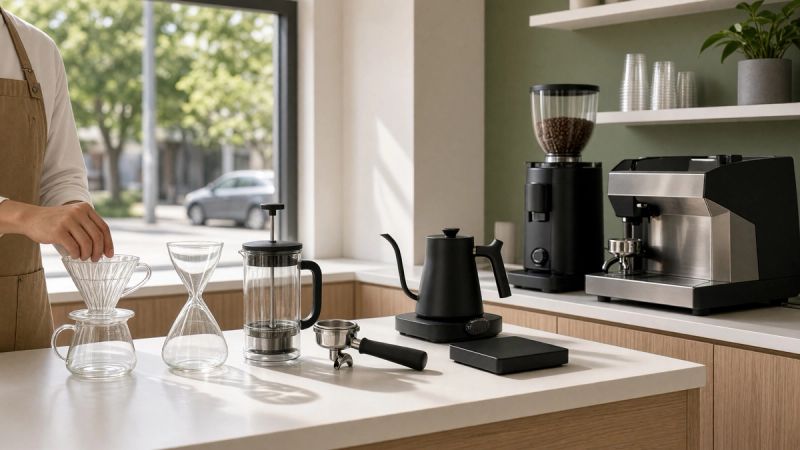
The choice of brewing method decisively influences the flavor, body, and clarity of your cup. Each method extracts coffee differently, and understanding these differences helps you achieve your ideal cup.
Extraction is usually read as brew strength (TDS) and extraction yield: the SCA Coffee Brewing Control Chart and UC Davis Coffee Center research are useful references when you dial ratio, grind, and time across V60, Chemex, AeroPress, and espresso.
V60 Pour-Over
The V60 has a 60-degree angle and a single large opening, allowing you to adjust the flow by modifying the grind size and pour rate. For a V60 at 2000 m above sea level, use 15 g of coffee per 250 g of water at 93 °C, with a medium-fine grind (~700 μm) and a total brew time of 2:45 minutes. The conical shape promotes even extraction and produces a bright and clean profile.
Chemex
The Chemex, with thicker walls and a three-layer paper filter, requires a slightly coarser grind (~800 μm) and a brew time of 4 minutes. This produces a lighter body and delicate notes due to the slower filtration. Start with 30 g of coffee per 500 g of water at 92 °C and use pulse pours.
AeroPress
The AeroPress pairs immersion with pressure for a concentrated cup with medium body—sweeter and less bitter than a short espresso, with more texture than a V60 or Chemex. It is the most forgiving option when you travel, have little counter space, or want a stable extraction in minutes.
Inverted AeroPress recipe (starting point)
- Dose: 17 g coffee
- Water: 250 g at 85 °C (cooler than V60/Chemex to curb bitterness)
- Grind: fine (~500 μm), between espresso and filter
- Bloom / immersion: 45 s with gentle stirring
- Press: finish by ~1:30 total; firm, steady pressure (~0.7 bar of hand effort)
- Ratio: ~1:15; dilute with hot water for americano-style
When to pick AeroPress: over V60 when you want speed, portability, and a rounder body without chasing maximum clarity; over Chemex when you prefer less delicate florals and more mouthfeel; over espresso when you lack a 9-bar machine but still want concentration and a soft crema. Stick with V60/Chemex for ultra-clean cups and espresso when you need shots for milk drinks.
Tasting expectations: sweetness, medium acidity, silky body, and chocolate or ripe-fruit notes depending on the beans. Sour? Grind finer or add 10–15 s immersion. Bitter? Lower temperature or shorten the press.
On temperature: SCA brew-temperature research finds little sensory change within ~87–93 °C when TDS and extraction are held constant — so AeroPress at 85 °C and V60 near 93 °C are starting recipes, not dogma. For grind tuning, see our grind-size science note.
To practice at home, use fresh beans and a decent grinder. The TOLO shop has whole-bean coffee and brewing gear; this guide is not catalog copy — it just passes you to /us/shop when you are ready to buy.
Espresso
Espresso uses 9 bar of pressure and very short extraction times. A standard recipe for high-elevation specialty coffees uses 18 g in the portafilter and produces 36 g of espresso in 28 seconds at a water temperature of 94 °C. The grind is very fine (~300 μm) and the 1:2 ratio yields a balance between sweetness and acidity. At 2000 m above sea level, it's recommended to adjust pump pressure to 8.5 bar due to lower atmospheric pressure.