The Art of Coffee Roasting: Science and Technique
Heating beans triggers Maillard reactions, caramelisation and pyrolysis. Maillard reactions start around 140 °C and produce aromatic compounds and colour; caramelisation intensifies at 160 °C. The first crack occurs between 190 °C and 196 °C when internal pressure causes expansion and release of steam. Second crack arises between 224 °C and 229 °C, indicating a dark roast where sugars degrade and bitter flavours increase.
Roast profile control involves managing rate of rise and total time. For light filter roasts, a typical profile lasts 9–11 minutes with final temperature 202 °C. Medium roasts extend to 12–14 minutes with final temperatures 210–218 °C. Maintaining a 10 °C per minute rise in the first half develops balanced complexity, while reducing the rate in the development phase (after first crack) highlights acidity and sweetness.
Weight loss and colour correlate: beans lose 12–20 % of mass due to moisture evaporation and CO₂ release. An Agtron colour of 65‑75 (light) associates with fruity and floral flavours, while 35‑45 (dark) corresponds to bitter chocolate and nutty profiles.
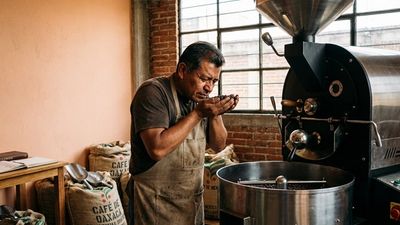
For home roasting, drum and fluid-bed roasters are available. Drum roasters provide precise control of airflow and heat transfer, ideal for 250 g to 1 kg batches. A typical session in a 500 g drum roaster charges at 160 °C and increases to 200 °C in the first 6 minutes. Fluid bed roasters use hot air to suspend beans, suitable for small batches (50‑150 g) and allow quicker profiles around 6–8 minutes.
It's crucial to use a thermocouple to measure bean temperature and record the profile. Control software such as Artisan or Cropster enables plotting the temperature curve and annotating events like first crack and start of development.
Roast level affects solubility and grind particle size. Light roasts require finer grinds and longer extraction times to achieve 20 % extraction yield; dark roasts, being more soluble, need coarser grinds and reduced extraction times to avoid bitterness.
Understanding the science and technique of roasting not only improves your ability to select beans in a coffee shop, but also opens the door to experimenting with profiles at home. With practice and attention to variables like temperature, time and development, you can highlight the intrinsic notes of each origin.