Coffee brewing methods compared: V60, Chemex, AeroPress, and espresso
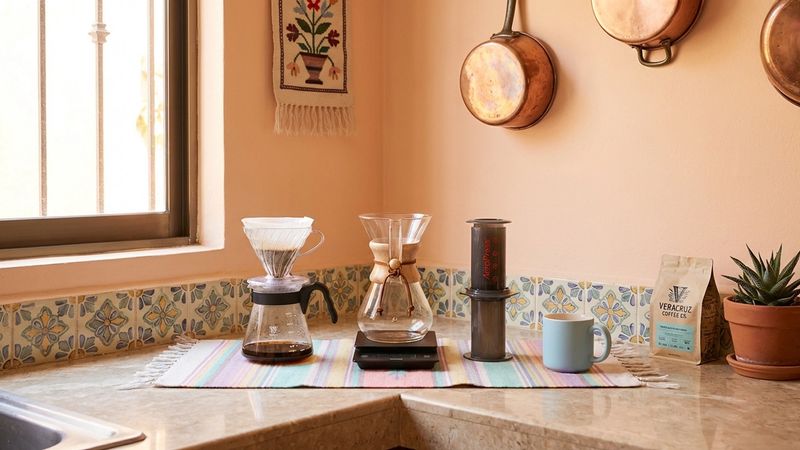
The choice of brewing method decisively influences the flavor, body, and clarity of your cup. Each method extracts coffee differently, and understanding these differences helps you achieve your ideal cup.
V60 Pour-Over
The V60 has a 60-degree angle and a single large opening, allowing you to adjust the flow by modifying the grind size and pour rate. For a V60 at 2000 m above sea level, use 15 g of coffee per 250 g of water at 93 °C, with a medium-fine grind (~700 μm) and a total brew time of 2:45 minutes. The conical shape promotes even extraction and produces a bright and clean profile.
Chemex
The Chemex, with thicker walls and a three-layer paper filter, requires a slightly coarser grind (~800 μm) and a brew time of 4 minutes. This produces a lighter body and delicate notes due to the slower filtration. Start with 30 g of coffee per 500 g of water at 92 °C and use pulse pours.
AeroPress
The Aeropress combines immersion and pressure, producing a concentrated beverage with medium body. For an inverted Aeropress, use 17 g of coffee and 250 g of water at 85 °C, a fine grind (500 μm), and a total time of 1:30 minutes, including 45 seconds of immersion before pressing. By varying the pressure and agitation, you can control extraction—mass transfer studies indicate that applying a constant pressure of about 0.7 bar increases extraction yield by up to 20%.
Espresso
Espresso uses 9 bar of pressure and very short extraction times. A standard recipe for high-elevation specialty coffees uses 18 g in the portafilter and produces 36 g of espresso in 28 seconds at a water temperature of 94 °C. The grind is very fine (~300 μm) and the 1:2 ratio yields a balance between sweetness and acidity. At 2000 m above sea level, it's recommended to adjust pump pressure to 8.5 bar due to lower atmospheric pressure.