The Art of Pour Over Coffee: Ratio, Bloom and Technique
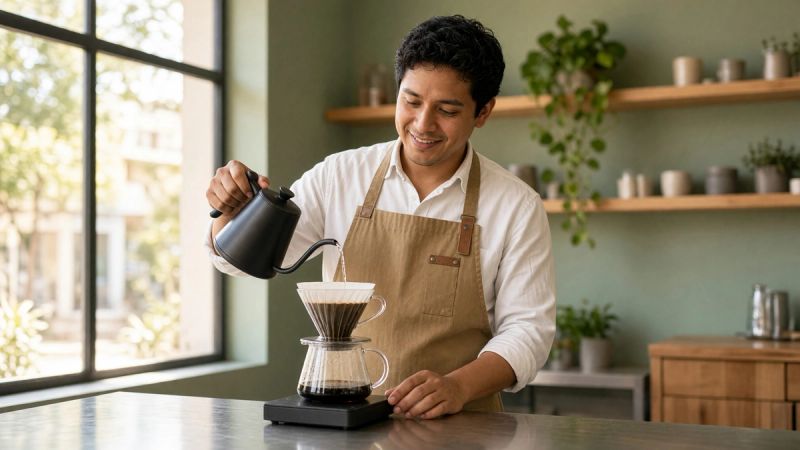
Pour over coffee is a manual brewing method that allows complete control over every extraction variable. From water temperature to pour speed, every decision impacts the final flavor of your cup.
Pour over coffee ratio: quick answer
Use 1 g of coffee for every 15–18 g of water, by weight. 1:16 is a balanced place to start: 20 g of coffee to 320 g of water. At TOLO we brew our V60, Orea O1 and Chemex recipes at 1:18 (20 g to 360 g) for a lighter, sweeter cup. Weigh the water you pour, not the coffee in your mug: the grounds hold on to some of it.
Pour over ratio chart (grams of water)
- 15 g coffee: 240 g water at 1:16, 270 g at 1:18
- 20 g coffee: 320 g water at 1:16, 360 g at 1:18 (our V60 and Orea O1 recipe)
- 30 g coffee: 480 g water at 1:16, 540 g at 1:18 (our Chemex recipe)
The formula is grams of coffee × ratio = grams of water. If the cup tastes weak or thin, move toward 1:16 or 1:15; if it feels heavy, go back toward 1:18. For the bloom, use two to three times the coffee's weight in water (our recipes use 60 g for 20 g of coffee). If the cup tastes sour or bitter rather than weak or strong, change the grind, not the ratio.
Popular Devices
The most popular devices include the V60, Chemex, and Kalita Wave. The V60 with its 60-degree angle and internal spirals offers a fast, bright extraction. The Chemex, with its thick filter, produces a cleaner, lighter cup.
Pour-over coffee is a manual brewing method that emphasizes both precision and artistry, giving the brewer full control over variables like grind size, water temperature, pour rate, and total brew time so the final cup clearly expresses the coffee’s character.
Popular Devices
- Hario V60 – Designed with spiral ridges and a large bottom opening, it encourages faster flow rates and can produce bright, complex cups when paired with an appropriate grind and pour technique.
- Chemex – Uses thick, proprietary paper filters that remove many oils and fine particles, resulting in an exceptionally clean, crisp-tasting cup with high clarity.
- Kalita Wave – Features a flat-bottom dripper with three small drainage holes and a wave-shaped filter, promoting even extraction and making it more forgiving of minor technique inconsistencies.
The Bloom
A proper pour-over begins with the bloom phase:
- Add ground coffee to the filter and level the bed.
- Pour just enough hot water to fully saturate the grounds—approximately twice the weight of the dry coffee (a 1:2 water-to-coffee ratio for this step).
- Allow the coffee to sit for 30–45 seconds.
During this time, fresh coffee releases trapped carbon dioxide, causing visible bubbling and expansion. This degassing step is crucial for promoting even water contact and uniform extraction in the subsequent pours.
Pour Technique
After the bloom:
- Pour in slow, steady circles, starting from the center and spiraling outward, then back toward the center.
- Maintain a relatively consistent water level in the dripper rather than letting it drain completely between pours.
- Avoid pouring directly onto the filter walls to prevent channeling and under-extraction.
Aim for a total brew time of 2:30–4:00 minutes, adjusting grind size and pour rate based on your specific device:
- Finer grind / slower pour → longer brew time, potentially more extraction.
- Coarser grind / faster pour → shorter brew time, lighter extraction.
The objective is a controlled, steady flow that highlights sweetness and complexity while minimizing bitterness or harshness.
Extraction variables: the SCA Brewing Control Chart, brew-temperature research (SCA), and the UC Davis Coffee Center.
Next, read our brewing methods comparison and water temperature guides. Whole beans are in the shop and at Pino Suárez in Toluca.